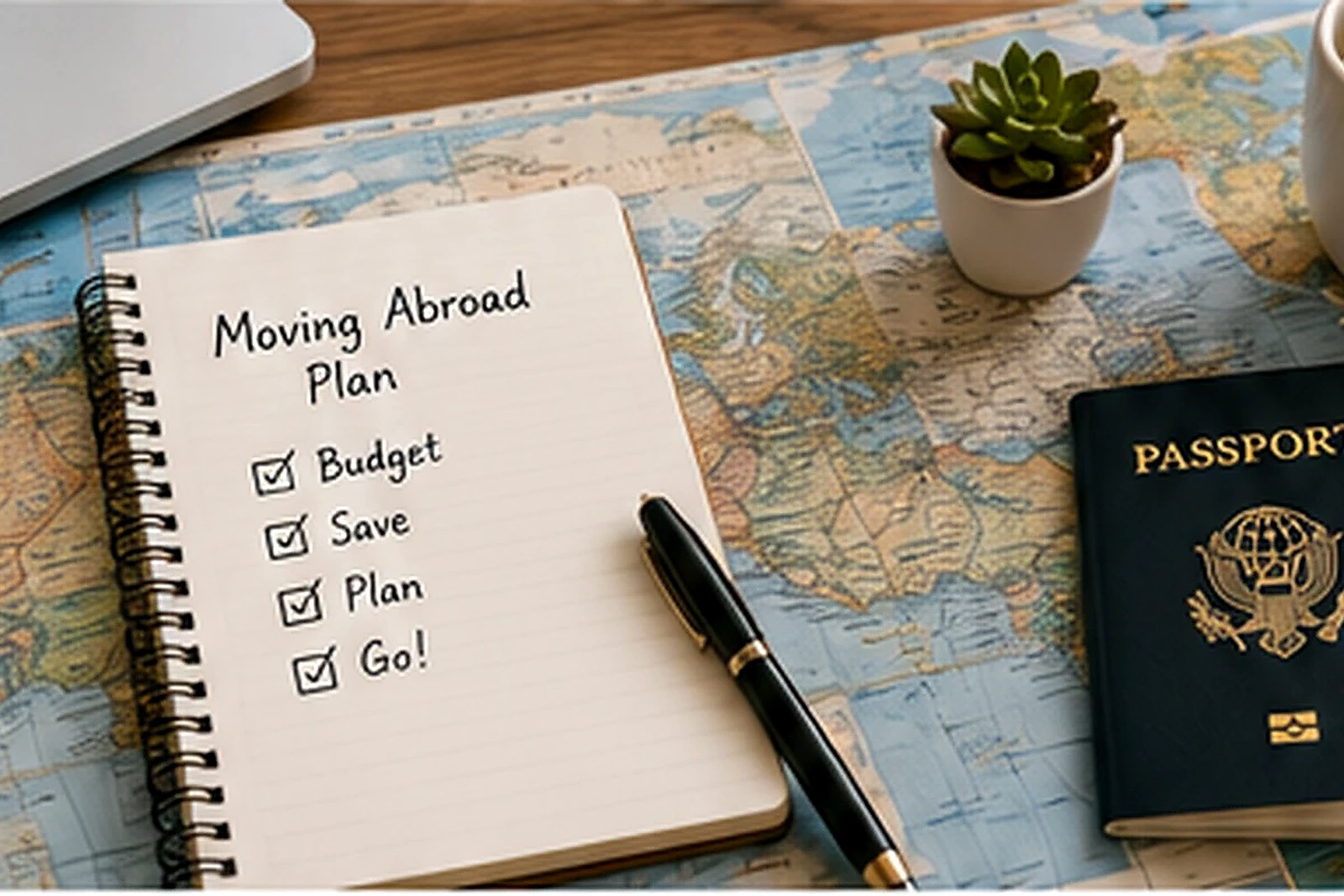
Moving abroad is exciting—but being financially prepared makes everything easier. The more planning you do before you leave, the less stressful your transition is likely to feel.
This guide will help you calculate a realistic savings target using your moving costs, setup costs, emergency savings, and an exit fund—so your number is built around your move, not somebody else’s budget.
The BooksOfTay Moving-Abroad Formula
Instead of choosing an arbitrary savings number, calculate what your move actually needs.
Moving Costs
Getting There
Setup Costs
Getting Established
Emergency Fund
Staying Safe
Move-Abroad Savings Checklist
Open each item as you build your number. You do not need every cost to be exact—you need a realistic plan and enough margin for surprises.
1. Getting there
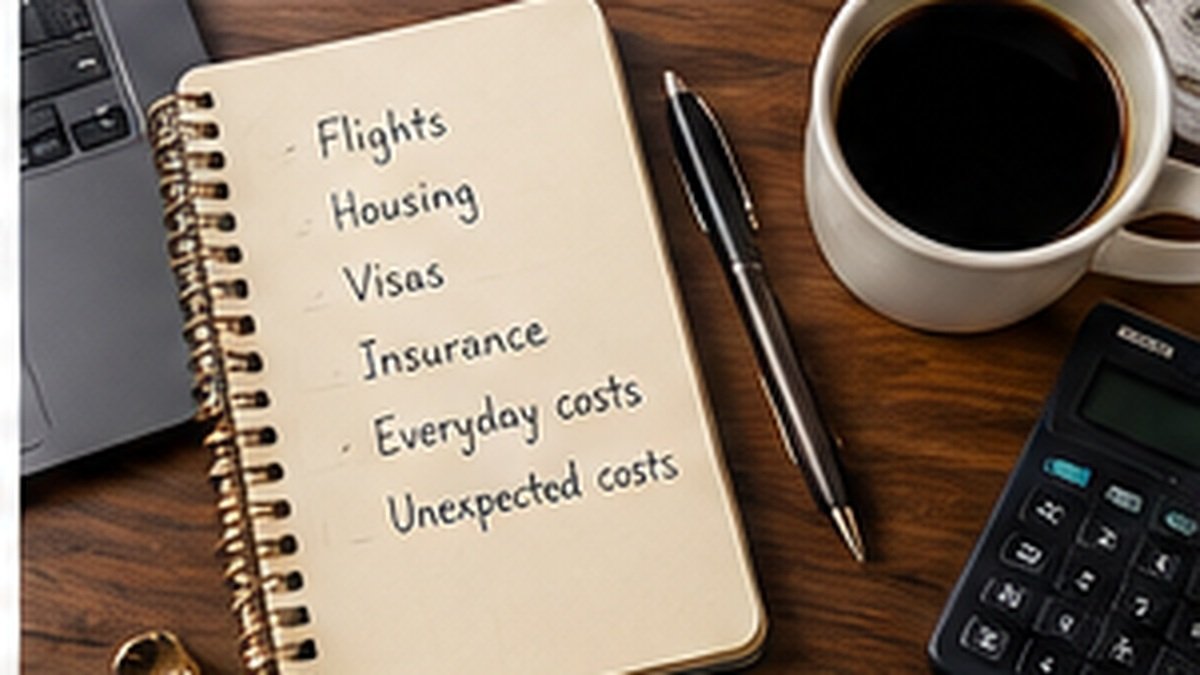
Estimate flights, baggage, visa/application fees, documents, temporary accommodation, airport transportation, shipping, storage, and any other departure costs.
2. Getting established
Estimate your first month of rent, security deposit, utilities, internet, phone/SIM, household basics, groceries, local transportation, and temporary housing while you settle in.
3. Protecting your runway
Choose an emergency-fund target based on income stability: roughly 3–6 months for stable income, more when income is variable, and substantially more if you are moving without ongoing income.
4. Keeping an exit option
Reserve accessible money for an emergency flight or relocation so a bad situation does not become a financial trap.
5. Checking legal requirements
Verify current visa, residency, insurance, income, and bank-balance requirements with the official authority for your destination before you finalize your savings target.
1. Calculate Your Moving Costs
Your first expenses happen before you’ve spent a single night in your new home.
Depending on your situation, they can include:
- One-way flight
- Extra baggage
- Visa/application fees
- Passport renewal
- Document legalization or apostilles
- Transportation from the airport
- Temporary accommodation
- Travel insurance
- Shipping
- Storage back home
- Pet relocation
- Initial transportation
Someone traveling with two suitcases will have a dramatically different moving budget from someone shipping furniture internationally.
That’s one reason I generally wouldn’t build your savings target around somebody else’s number.
Build it around your move.
Example
Imagine you’re moving alone and traveling relatively light:
Flight: $700
Extra baggage: $200
Visa/documents: $300
Temporary accommodation: $600
Airport/local transportation: $100
Miscellaneous departure costs: $300
Estimated moving cost: $2,200
Now we have our first number.
But landing in the country isn’t the same thing as being established there.
2. Calculate Your Setup Costs
This is the category people frequently underestimate.
Your first month abroad probably won’t look like month six.
You may need to pay for things such as:
- Security deposit
- First month’s rent
- Utility deposits
- SIM/eSIM
- Internet setup
- Basic household items
- Bedding
- Kitchen supplies
- Transportation
- Local bank/account requirements
- Gym membership
- Groceries
- Visa extensions or residency expenses
- Temporary accommodation while apartment hunting
Suppose your long-term apartment costs $600/month.
You might need:
First month: $600
Security deposit: $600
Household setup: $400
Phone/internet: $100
Transportation/setup expenses: $200
Miscellaneous: $300
That’s another:
$2,200
Our hypothetical move has now cost:
$2,200 to get there
$2,200 to get established
=
$4,400
And we still haven’t touched your emergency fund.
3. Build an Emergency Fund
This is the money I would treat differently from moving money.
It isn’t there to upgrade your apartment.
It isn’t there because you saw a cheap flight to another country.
It isn’t there because you want a new laptop.
It’s there because life happens.
You could:
Lose your job.
Lose a client.
Have your bank card frozen.
Need an unexpected flight home.
Need medical treatment.
Have an apartment problem.
Need to leave the country unexpectedly.
Experience a major currency movement.
Have a visa issue.
When you’re living overseas, having financial breathing room becomes especially valuable because your normal support systems may be thousands of miles away.
The U.S. government specifically advises Americans traveling abroad to prepare for emergency financial situations. In extreme circumstances, U.S. embassies may help facilitate emergency funds or repatriation assistance, but government assistance isn’t something you should build your financial plan around.
Your own emergency fund should be Plan A.
How Many Months of Emergency Savings Should You Have?
I would think about this based on income stability.
Stable remote income
Consider approximately:
3–6 months of essential living expenses
If your essential overseas expenses are $1,500/month:
3 months = $4,500
6 months = $9,000
Variable freelance/business income
I’d lean more conservative:
6–9 months
At $1,500/month:
6 months = $9,000
9 months = $13,500
No ongoing income
This changes the equation considerably.
I’d want:
6–12 months of living expenses
plus
all moving and setup costs
Moving abroad hoping you’ll “figure out the income later” creates much more financial risk.
Your Emergency Fund Should Include an Exit Plan
Here’s something that doesn’t get discussed enough.
Your emergency fund shouldn’t only answer:
“Can I continue living here?”
It should also answer:
“Can I leave?”
Keep enough accessible money for an emergency flight or relocation if necessary.
Call it your:
Exit Fund
Maybe you never use it.
That’s the goal.
But if something goes seriously wrong, you don’t want the price of an airline ticket deciding whether you’re trapped in a bad situation.
For many people, setting aside $1,000–$2,000 specifically for emergency transportation could provide valuable additional protection depending on where they’re living and where they’d need to go.
The $1,500-a-Month Example
Let’s put everything together.
Suppose you’ve chosen a country where you expect to spend:
$1,500/month
You also have reliable remote income.
Your numbers might look something like this:
Getting There
Flight + baggage: $900
Documents/visa: $300
Temporary accommodation: $600
Other moving expenses: $400
Moving costs: $2,200
Getting Established
Apartment deposit: $600
First month’s rent: $600
Household setup: $400
Phone/internet: $100
Other setup expenses: $500
Setup costs: $2,200
Emergency Fund
3 months × $1,500
$4,500
Exit Fund
$1,500
Total
$2,200 + $2,200 + $4,500 + $1,500
$10,400
That’s much more useful than someone simply telling you:
“You need $10,000 to move abroad.”
Now you know why you have $10,400.
And your number could be higher or lower.
What If You Only Have $5,000?
That doesn’t automatically mean you can’t move abroad.
But the margin for error becomes smaller.
A $5,000 move becomes more realistic when you have:
- Reliable ongoing income
- A low-cost destination
- Minimal debt obligations
- Affordable airfare
- Few possessions
- Simple visa requirements
- Low setup costs
- Health coverage
- A backup bank/card
- Somewhere you could return to if necessary
I would be much more cautious about moving abroad with $5,000 if you have no reliable income.
The important question isn’t:
“Can I physically get there with $5,000?”
You probably can in many situations.
The question is:
“What happens if something goes wrong 45 days later?”
That’s the difference between being able to travel somewhere and being financially prepared to live there.
What If You Have $10,000?
For a solo person with stable remote income moving to a relatively affordable destination, $10,000 can create considerably more breathing room.
You may be able to cover:
- Travel
- Apartment deposits
- Initial setup
- Several months of essential expenses
- Emergency transportation
without immediately depending on your next paycheck.
But again, destination matters.
$10,000 means something very different in Da Nang than it does in Zurich.
What If You Have $20,000?
Now you’re beginning to create a much larger buffer.
That doesn’t mean you should spend more simply because you have more.
The advantage of having $20,000 isn’t:
“Now I can get a luxury apartment.”
The advantage is:
“I don’t need everything to go perfectly.”
That’s powerful.
A delayed paycheck doesn’t become a crisis.
A bad apartment doesn’t force you to stay.
A flight home doesn’t wipe you out.
You have options.
And options are a form of freedom.
Don’t Forget Visa Financial Requirements
Your personal comfort number isn’t necessarily your legal eligibility number.
Certain residence and digital-nomad visas require proof of:
- Monthly income
- Bank balances
- Savings
- Employment
- Insurance
- Accommodation
For example, some current remote-worker and residency programs require applicants to demonstrate thousands of dollars per month in income or substantial savings.
Always check the official immigration authority for your destination before building your plan.
Don’t save $8,000 for a move only to discover that the visa you’re targeting requires significantly more financial evidence.
Don’t Put Every Dollar Into the Move
This is another mistake I’d avoid.
Suppose you’ve saved $12,000.
That doesn’t mean you have:
$12,000 to spend moving abroad.
Some of that money should remain untouched.
Think:
Move Money
and
Safety Money
as two separate accounts—even if they’re technically sitting in the same bank.
If your move costs $5,000 and you have $12,000:
$5,000 = transition
$7,000 = protection
That’s psychologically different from treating the entire $12,000 as spending money.
Your Banking Setup Matters Too
Having enough money doesn’t help much if you suddenly can’t access it.
Before leaving, think about having:
- More than one debit card
- More than one payment method
- A bank that works internationally
- Emergency cash
- A way to transfer money internationally
- Online access to U.S. financial accounts
- Updated contact information
- Secure two-factor authentication
- A backup plan if a card gets frozen
Don’t keep your entire overseas financial life dependent on one card from one bank.
This will be something we’ll explore separately in Money Abroad.
Don’t Forget Healthcare
Your emergency fund isn’t a substitute for proper insurance.
The U.S. State Department warns that the U.S. government does not pay medical bills for Americans overseas and notes that many U.S. health plans don’t provide normal international coverage.
Before moving, understand:
- What your existing insurance covers
- Local healthcare costs
- International health insurance
- Emergency medical coverage
- Medical evacuation coverage
A cheap country doesn’t automatically mean every medical emergency will be cheap.
How to Calculate Your Personal Move-Abroad Number
Grab your calculator.
Step 1
Estimate your one-time moving expenses.
$__________
Step 2
Estimate your initial setup costs.
$__________
Step 3
Calculate your essential monthly overseas expenses.
$__________ × ___ months
Step 4
Add your emergency exit fund.
$__________
Step 5
Add any visa-required financial amount that must remain available.
$__________
Now total everything.
Your Move-Abroad Number: $__________
That’s the number that matters.
Not somebody else’s TikTok budget.
Not what a YouTuber says they spend.
Yours.
Should You Wait Until You Have the Perfect Amount?
Probably not forever.
There will always be another reason to save another $5,000.
At some point, excessive preparation can become another form of never leaving.
The goal isn’t to eliminate every possible risk.
That’s impossible.
The goal is to build enough financial margin that normal problems don’t destroy your plan.
If you have:
Reliable income + realistic budget + moving costs + emergency savings + an exit plan
you’re in a much stronger position than someone who simply bought a one-way ticket because life abroad looked cheap online.
Your Next Chapter Shouldn’t Begin With Financial Panic
Moving abroad can create incredible opportunities.
Lower living costs.
New cultures.
Different lifestyles.
More freedom.
A chance to discover somewhere that fits you better.
But geographic arbitrage works best when you’re moving from a position of preparation, not desperation.
You don’t need to be rich.
You don’t necessarily need $50,000 sitting in a bank account.
You need to understand your numbers.
Know what getting there costs.
Know what getting established costs.
Know what living there costs.
And have enough left over that one unexpected problem doesn’t send you immediately back home.
Because your savings aren’t just financing the move.
They’re buying you time, choices and the freedom to give your next chapter a real chance.
Frequently Asked Questions
Is $5,000 enough to move abroad?
It can be possible in some lower-cost destinations if you have reliable ongoing income, low setup costs, health coverage, backup payment methods, and somewhere to return to. The margin for error is much smaller without reliable income.
Is $10,000 enough to move abroad?
For a solo person with stable remote income moving to a relatively affordable destination, $10,000 can create meaningful breathing room for travel, deposits, setup costs, several months of essential expenses, and emergency transportation.
How many months of emergency savings should I have?
The guide suggests roughly 3–6 months of essential expenses for stable remote income, 6–9 months for variable freelance or business income, and 6–12 months plus moving and setup costs when you have no ongoing income.
What is an exit fund?
An exit fund is accessible money reserved for an emergency flight or relocation if you need to leave. The article suggests that $1,000–$2,000 may provide useful additional protection for many people, depending on where they live and where they would need to go.
Do visa requirements affect how much I need to save?
Yes. Some residence and remote-work visas require proof of income, savings, bank balances, insurance, or accommodation. Always verify the current requirements with the official immigration authority for your destination.

Join the Conversation
Have experience with this destination or topic? Share your perspective or questions below. We’d love to hear from you.
Leave a Comment